When Should Your Business Shred Old Tax Records?
Tax season creates paperwork. Years of tax seasons create storage rooms full of it.
Businesses accumulate tax returns, payroll records, invoices, receipts, bank statements, employee information, accounting records, and other documents containing sensitive financial and personally identifiable information.
At the same time, much of that information now exists electronically. Old accounting computers, laptops, servers, hard drives, and backup media can contain years of financial records long after the equipment has been retired.
So when tax records reach the end of their required retention period, the question isn’t simply, “Can we throw these away?”
The better question is:
What information can we legally destroy, where is it stored, and what is the appropriate method for securely disposing of it?
Secure Shredding and E-recycling helps businesses address the complete information lifecycle through document shredding, mobile paper shredding, hard drive destruction, business electronics recycling, and IT asset disposition.
The basic approach is:
Expired paper records → secure shredding → recycling
Data-bearing media → secure data destruction
Obsolete electronics → responsible electronics recycling
Reusable technology → secure ITAD and potential remarketing
What Business Tax Records Should You Keep?
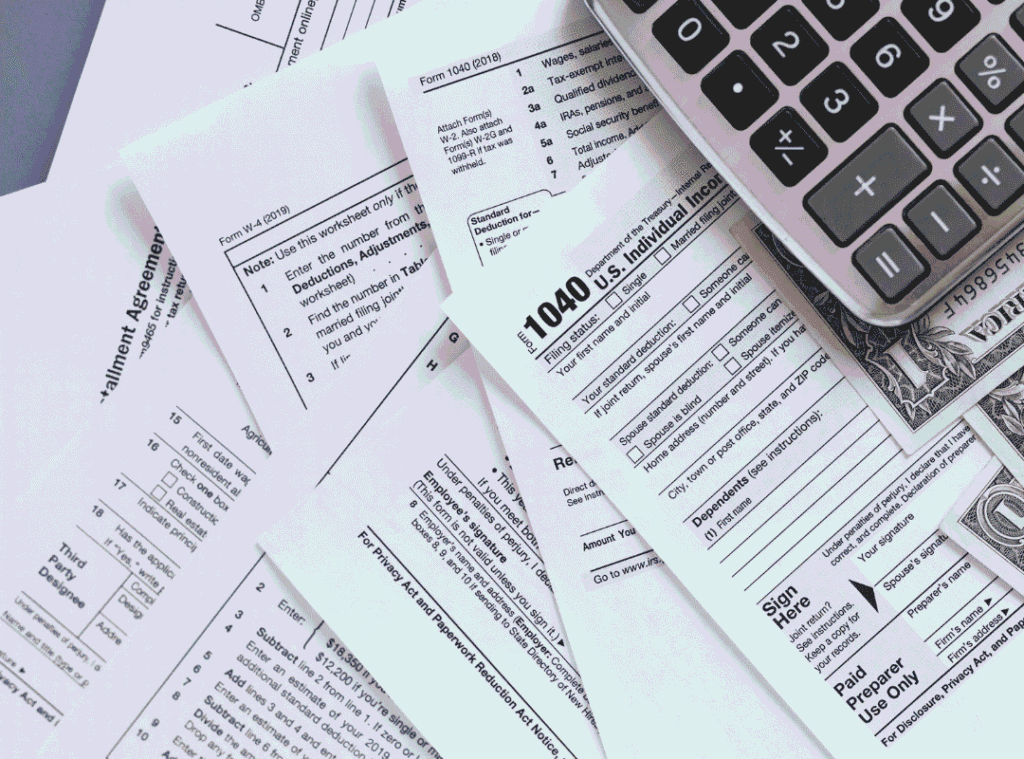
Businesses should maintain records that support the information reported on their tax returns.
Depending on the organization, those records may include:
- Tax returns
- Payroll records
- W-2s and 1099s
- Invoices
- Receipts
- Bank statements
- Credit card statements
- Canceled checks
- Expense documentation
- Asset and depreciation records
- Employee tax information
- Accounting reports
- Documents supporting income, deductions, and credits
The IRS explains that business records help organizations identify income, track deductible expenses, prepare financial statements, prepare tax returns, and support items reported on those returns.
That means businesses should not automatically shred tax documents simply because another April 15 has passed.
How Long Should Businesses Keep Tax Records?
There isn’t one retention period that applies to every business tax document.
The IRS states that records generally need to be kept for as long as they may be necessary to administer the applicable provisions of the Internal Revenue Code.
For many income-tax records, that means retaining documents until the applicable period of limitations has expired. A common period is three years, but certain circumstances require longer retention.
For example:
| Record or Circumstance | General IRS Retention Guidance |
|---|---|
| Many records supporting income, deductions or credits | 3 years |
| Certain claims involving worthless securities or bad debts | 7 years |
| Certain substantial unreported income situations | 6 years |
| Employment tax records | At least 4 years |
| Certain property records | Until the applicable period after disposition expires |
| No return filed or fraudulent return | Indefinitely |
These are general federal guidelines, not a universal records-retention schedule.
Businesses may have additional requirements from state laws, industry regulations, contracts, insurance companies, creditors, litigation holds, or internal policies.
Before destroying anything:
Identify the record → verify retention requirements → authorize destruction → securely destroy it
Secure Shredding and E-recycling provides secure destruction services but does not determine how long your organization is legally required to retain a particular record.
Why Tax Records Shouldn’t Go in the Regular Trash
Business tax records can contain exactly the information organizations work hard to protect.
Think about what may appear in an accounting or tax file:
- Names
- Addresses
- Social Security numbers
- Employer Identification Numbers
- Bank account information
- Payroll data
- Customer information
- Employee information
- Signatures
- Income information
- Credit card information
- Financial statements
Putting those documents into ordinary trash or an open recycling bin can unnecessarily expose confidential information.
A better process is:
Confidential record → secure collection → professional destruction → documented completion
That’s where professional business document destruction becomes part of a broader information-security program.
Mobile Paper Shredding Makes Annual Tax Purges Easier
Tax season can be a natural reminder to review older records.
If your organization determines that several years of documents have reached the end of their required retention periods, one-time shredding services can help clear accumulated files at once.
For larger cleanouts, mobile paper shredding allows confidential documents to be securely destroyed at your location.
This can be especially useful for:
- Accounting firms
- Financial institutions
- Medical practices
- Law firms
- Corporate offices
- Small and midsize businesses
- Government agencies
- Schools and universities
Instead of assigning employees to spend hours using office shredders, a professional purge shredding service can process larger quantities through a controlled destruction process.
For businesses that generate sensitive financial records throughout the year, ongoing shredding and secure collection containers can establish a consistent process between annual cleanouts.
Your Tax Data Doesn’t Only Live on Paper
This is where tax-record security has changed significantly.
Many businesses now create, store, transmit, and retain financial information digitally.
Accounting systems, payroll software, scanned receipts, tax returns, spreadsheets, employee files, and financial reports may be stored on:
- Desktop computers
- Laptops
- Hard drives
- SSDs
- Servers
- External storage devices
- Backup media
- Mobile devices
That means shredding paper records while ignoring retired technology leaves part of the information lifecycle unfinished.
Paper tax record → document shredding
Digital tax record → secure data management
Retired storage media → data destruction
Obsolete computer → electronics recycling
Reusable computer → ITAD
A modern tax-record cleanout should account for both physical and electronic information.
Hard Drive Destruction Protects Retired Financial Data
Imagine replacing an accountant’s computer after several years.
The physical device may no longer be useful to the organization, but its storage media could contain years of tax returns, payroll reports, financial statements, customer records, employee information, and accounting data.
That information needs to be addressed before the device leaves organizational control.
Hard drive destruction provides an option for storage media that no longer needs to remain functional.
For applicable projects, asset and serialized reporting can also provide additional documentation.
The process should be intentional:
Retire device → identify data-bearing media → securely address data → document disposition
Electronics Recycling Should Be Part of a Tax-Season Technology Cleanout
Once the data is addressed, businesses still need to determine what happens to obsolete equipment.
Business electronics recycling provides a responsible path for equipment that has reached the end of its useful life.
This is increasingly important as electronic waste continues to grow globally.
The Global E-waste Monitor 2024 reported that approximately 62 million metric tons of e-waste were generated worldwide in 2022, while only 22.3% was documented as formally collected and recycled in an environmentally sound manner.
For businesses replacing accounting computers, servers, monitors, and other office technology, responsible electronics recycling addresses the physical equipment after its data-security requirements have been handled.
Protect the data first. Responsibly manage the equipment second.
ITAD Can Recover Value From Reusable Technology
Not every computer being removed from an accounting department is ready to become electronic waste.
Some laptops, desktops, servers, and other assets may still have useful life or market value.
IT asset disposition and remarketing provides another path.
An ITAD program may include:
- Asset inventory
- Serial-number tracking
- Secure data sanitization or destruction
- Equipment evaluation
- Testing
- Refurbishment
- Remarketing
- Recycling
- Final reporting
That creates two potential outcomes:
No remaining value → secure data handling + electronics recycling
Remaining value → secure data handling + IT asset remarketing
For organizations refreshing accounting or finance department technology, ITAD can support data security, sustainability, asset accountability, and potential value recovery.
What Should You Shred, Destroy, Recycle or Remarketing?
| Business Asset | Primary Concern | Recommended Service |
|---|---|---|
| Expired paper tax records | Confidential financial data | One-time purge shredding |
| Daily financial paperwork | Ongoing information exposure | Secure containers + scheduled shredding |
| Large archive cleanout | Security + employee time | Mobile paper shredding |
| Accounting computer hard drives | Recoverable financial data | Hard drive destruction |
| Backup media | Stored financial information | Secure media destruction |
| Obsolete computers | Data + equipment disposal | Electronics recycling |
| Reusable laptops/desktops | Data + residual value | ITAD/remarketing |
| Retired servers | Large volumes of business data | Data destruction + ITAD |
| Technology refresh | Security + sustainability + tracking | ITAD + electronics recycling |
The goal isn’t to destroy everything.
The goal is to retain what must be retained and securely dispose of what no longer needs to exist.
NAID AAA Certification Provides Independent Verification
Businesses should carefully evaluate any company entrusted with tax records, financial information, or data-bearing devices.
Secure Shredding and E-recycling is NAID AAA Certified for secure information destruction.
Administered by i-SIGMA, NAID AAA Certification uses independent audits to verify that certified providers meet established information-destruction security requirements.
The certification program addresses areas including secure operational processes, employee screening, chain of custody, and information destruction. Certified providers are subject to ongoing scheduled and unannounced audits.
For businesses evaluating a commercial document shredding or secure data destruction provider, independent certification provides an additional vendor due-diligence measure.
HIPAA, FACTA and GLBA May Affect Information Disposal
Tax and financial records can overlap with other categories of regulated information.
HIPAA
Healthcare organizations may maintain financial records that also contain protected health information.
HHS requires covered entities to apply appropriate safeguards when disposing of PHI. For paper records, shredding is among the methods HHS identifies for rendering PHI essentially unreadable and unable to be reconstructed. Electronic media also requires appropriate disposal procedures.
FACTA
The FACTA Disposal Rule requires covered organizations to take reasonable measures when disposing of certain consumer-report information.
FTC guidance identifies shredding paper and destroying or erasing electronic media so information cannot practicably be read or reconstructed as examples of reasonable disposal measures.
GLBA
Financial institutions subject to the Gramm-Leach-Bliley Act Safeguards Rule must maintain safeguards designed to protect customer information.
For covered businesses, that reinforces the need to consider information throughout its lifecycle—from active use and storage to eventual destruction.
Professional shredding and data destruction can support compliance efforts, but organizations remain responsible for determining their specific regulatory, contractual, legal, and retention requirements.
Documentation Matters After the Records Are Gone
Once confidential tax records or hard drives have been destroyed, the original information is no longer available to prove what happened.
Documentation therefore becomes an important part of the process.
Secure Shredding and E-recycling provides Certificates of Destruction for applicable services, along with asset and serialized reporting options for certain electronics and hard drive destruction projects.
That documentation can support:
- Internal audits
- Records-management programs
- Compliance procedures
- Vendor due diligence
- Chain-of-custody requirements
- IT asset inventories
- Sustainability reporting
Secure destruction should not simply happen. Businesses should be able to document that it happened.
Frequently Asked Questions
How long should a business keep old tax records before shredding them?
The retention period depends on what the record supports and the circumstances involved. Many federal tax records are commonly retained for at least three years, while some records require longer periods. Employment tax records generally must be retained for at least four years. Businesses should verify applicable IRS, state, legal, contractual, and industry requirements before authorizing destruction.
What is the safest way for a business to destroy old tax documents?
Once records have reached the end of their required retention period, professional document shredding provides a controlled method of destruction. Businesses with larger quantities can use one-time purge or mobile paper shredding instead of relying on small office shredders.
Can businesses recycle computers that contain old tax and accounting records?
Yes, but the data should be appropriately addressed first. Secure Shredding and E-recycling provides hard drive destruction, business electronics recycling, and ITAD services to help organizations securely manage data-bearing equipment before recycling or remarketing.
What is the difference between electronics recycling and ITAD for old accounting computers?
Electronics recycling is generally appropriate for obsolete equipment at the end of its useful life. IT asset disposition (ITAD) can include asset tracking, secure data sanitization or destruction, testing, refurbishment, remarketing, recycling, and reporting for equipment that may still have value.
Why use a NAID AAA Certified shredding company for business tax records?
NAID AAA Certification provides independent verification of established information-destruction security practices. Certified providers undergo scheduled and unannounced audits, providing businesses with an additional vendor due-diligence measure when selecting a provider to handle confidential financial information.
Tax Season Is a Good Time to Review Your Entire Information Lifecycle
Filing this year’s taxes doesn’t necessarily mean you can destroy last year’s records.
But tax season is a useful reminder to review what your organization has accumulated—and determine what has legitimately reached the end of its retention period.
And don’t stop at the filing cabinets.
Look at the accounting department’s retired computers. Check the IT closet. Identify unused hard drives and servers. Determine which equipment can be recycled and which still has value.
Then give every asset the appropriate next step:
Expired paper records → secure shredding.
Hard drives → secure data destruction.
Obsolete electronics → responsible electronics recycling.
Reusable technology → secure ITAD and remarketing.
Secure Shredding and E-recycling provides document shredding, mobile paper shredding, one-time shredding services, hard drive destruction, business electronics recycling, and IT asset disposition services for organizations that need a more complete approach to secure information disposal.
Contact Secure Shredding and E-recycling to request a quote.
Call Us Today! 1-(833) 747-3399