One-Time Shredding, Electronics Recycling & ITAD: When Does Your Business Need Them?
Sensitive information has a way of accumulating.
Old customer files fill storage rooms. Tax and payroll records remain in filing cabinets. Retired laptops collect in IT closets. Hard drives are removed from computers but never properly destroyed. Equipment from the last technology refresh sits untouched because no one has decided whether it should be recycled, reused, or resold.
For businesses, that accumulation is more than clutter. It can create unnecessary security, compliance, operational, and environmental risk.
A one-time cleanout can address all of it.
Secure Shredding and E-recycling helps businesses securely manage end-of-life information through one-time paper shredding, mobile document destruction, hard drive destruction, electronics recycling, and IT asset disposition (ITAD).
The goal is straightforward:
Old paper → secure shredding → recycling
Data-bearing media → secure data destruction
Obsolete electronics → responsible electronics recycling
Reusable technology → secure ITAD and potential remarketing
What Is One-Time Document Shredding?
One-time shredding, sometimes called purge shredding, is designed for businesses that have accumulated confidential records but do not necessarily need recurring service.
Instead of asking employees to spend hours feeding documents through office shredders, a professional provider can securely destroy large quantities at once.
Common one-time shredding projects include:
- Annual records cleanouts
- Office relocations
- File-room cleanouts
- Records-retention purges
- Mergers and acquisitions
- Facility closures
- Digitization projects
- Tax-season cleanups
- Archived customer or employee files
Secure Shredding and E-recycling offers both mobile paper shredding and off-site shredding, allowing businesses to choose a process that works for their security requirements and operations.
Why Can a One-Time Shredding Project Pay Off?
Keeping confidential records longer than necessary can increase exposure without adding business value.
Old documents may contain customer names, Social Security numbers, financial information, employee records, medical information, account numbers, contracts, or proprietary company information.
Once the appropriate legal and business retention period has passed, continuing to store those records can mean continuing to protect information the organization no longer needs.
A defined destruction process changes that:
End of retention → authorized disposal → secure collection → professional destruction → Certificate of Destruction
Businesses should always follow applicable legal, regulatory, contractual, and internal retention requirements before authorizing destruction. Secure Shredding and E-recycling provides destruction services but does not determine how long an organization is legally required to retain its records.
One-Time Mobile Shredding Can Save Employee Time
An office shredder may work for a handful of pages. It becomes far less practical when a company has dozens or hundreds of boxes to destroy.
Employees still have to gather records, feed documents into the machine, clear jams, empty the shredder, and dispose of the resulting paper.
Mobile shredding moves that work into a professional process.
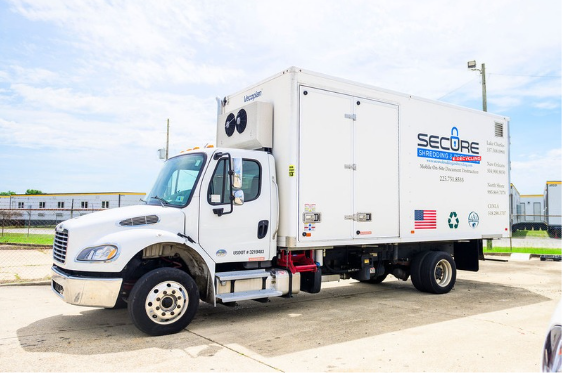
Confidential records are collected and brought to the mobile shredding truck for destruction at your location. Businesses can therefore complete large purge projects without assigning employees to destroy documents one stack at a time.
After destruction, the resulting paper is sent for recycling.
For businesses that continue generating confidential paper after the purge, a one-time project can also be the starting point for an ongoing shredding program using secure collection containers.
Your Cleanout Should Include More Than Paper
A records cleanout is also a good time to look beyond the filing cabinets.
Walk into almost any long-established office and you may find a collection of outdated technology:
- Laptops
- Desktop computers
- Hard drives and SSDs
- Servers
- External drives
- Backup tapes
- Mobile devices
- Printers and copiers
- Networking equipment
- Monitors
- Other peripherals
Some of those devices may contain sensitive information. Others may still have financial value.
That is why a complete business cleanout should consider paper shredding, data destruction, electronics recycling, and ITAD together.
Hard Drive Destruction Addresses Data That Paper Shredding Cannot
A company can securely shred every paper record in the building and still leave years of confidential information behind on its old technology.
Deleting files or retiring a computer does not automatically resolve the data stored on its media.
For storage devices that no longer need to remain functional, hard drive destruction provides a physical data-destruction option.
This can be especially valuable during:
- Computer refreshes
- Server upgrades
- Office moves
- IT storage-room cleanouts
- Mergers
- Facility closures
- Large-scale device replacements
Businesses can also request serialized hard-drive tracking when additional asset-level documentation is required.
The principle is simple:
Device retired → data addressed → media destroyed or sanitized → disposition documented
Electronics Recycling Provides a Responsible Path for Obsolete Equipment
Once data security has been addressed, businesses still have to determine what happens to the equipment.
Business electronics recycling provides a responsible destination for technology that has reached the end of its useful life.
And the need is growing.
According to the Global E-waste Monitor 2024, the world generated approximately 62 million metric tons of e-waste in 2022. Only 22.3% was documented as formally collected and recycled in an environmentally sound manner. Global e-waste generation is projected to reach approximately 82 million metric tons by 2030.
For businesses, responsible electronics recycling can address two priorities at once:
Securely manage the information → responsibly manage the physical equipment.
ITAD Can Help Recover Value From Reusable Technology
Not everything in an IT closet is necessarily waste.
Some retired laptops, desktops, servers, smartphones, and other technology may still have useful life and market value.
That is where IT asset disposition and remarketing differs from traditional electronics recycling.
An ITAD program may include asset evaluation, inventory, secure data sanitization or destruction, testing, refurbishment, remarketing, recycling, and final reporting.
That creates two potential outcomes:
No remaining value → secure data handling + electronics recycling
Remaining value → secure data handling + IT asset remarketing
For businesses completing large technology refreshes, ITAD can combine security, sustainability, asset accountability, and potential value recovery.
What Should Your Business Shred, Destroy, Recycle or Remarketing?
| Business Material | Primary Risk | Recommended Service |
|---|---|---|
| Archived paper records | Confidential information | One-time paper shredding |
| Daily confidential paperwork | Unauthorized access | Scheduled shredding + secure containers |
| Large file-room inventory | Volume + information exposure | Mobile purge shredding |
| Hard drives and SSDs | Recoverable business data | Hard drive destruction |
| Backup media | Stored confidential information | Secure media destruction |
| Obsolete computers | Data + physical disposal | Electronics recycling |
| Reusable laptops/desktops | Data + remaining value | ITAD/remarketing |
| Servers/networking equipment | High-value organizational data | Data destruction + ITAD |
| Large technology refresh | Security + sustainability + tracking | ITAD + electronics recycling |
A successful cleanout does not simply remove unwanted material. It determines the appropriate disposition for each asset.
NAID AAA Certification Adds Independent Verification
When a business hires someone to handle confidential records or data-bearing devices, that vendor becomes part of its information-security process.
Secure Shredding and E-recycling is NAID AAA Certified for secure information destruction.
NAID AAA Certification is administered by i-SIGMA and uses a rigorous audit program to independently verify that certified providers follow established security processes. Certification includes areas such as chain of custody, employee screening, operational security, and information-destruction procedures.
Certified providers are subject to ongoing scheduled and unannounced audits and must renew certification annually.
For businesses comparing shredding and data-destruction companies, that provides an important third-party trust signal rather than relying solely on a provider’s own security claims.
HIPAA, FACTA and GLBA Make Secure Disposal Important
Depending on your industry and the information your organization maintains, secure disposal may also be part of a larger compliance program.
HIPAA
The U.S. Department of Health and Human Services states that covered entities must apply appropriate safeguards when disposing of protected health information. HHS identifies shredding as one method for rendering paper PHI unreadable and unable to be reconstructed. Appropriate electronic-media disposal may involve clearing, purging, or physically destroying the media.
FACTA
The FTC’s FACTA Disposal Rule requires covered organizations to take reasonable measures when disposing of certain consumer-report information. FTC guidance identifies shredding paper and destroying or erasing electronic media so information cannot practicably be read or reconstructed as examples.
GLBA
Financial institutions covered by the Gramm-Leach-Bliley Act Safeguards Rule have obligations to protect customer information. A secure information lifecycle should therefore account for confidential information in both physical and electronic formats.
Professional shredding and data-destruction services can support compliance efforts, but each organization remains responsible for determining which laws, retention requirements, contractual obligations, and internal policies apply.
Documentation Builds Trust After the Material Is Gone
Once a box of records is shredded or a hard drive is destroyed, the physical evidence is gone.
Documentation provides the record of what happened.
Secure Shredding and E-recycling provides Certificates of Destruction for applicable services, along with asset tracking and serialized reporting options for certain electronic-media projects.
That documentation can support:
- Internal audits
- Vendor due diligence
- Compliance programs
- Records-management policies
- IT asset inventories
- Chain-of-custody requirements
- Sustainability reporting
For B2B buyers evaluating a secure destruction company, these operational details matter as much as the shredding equipment itself.
When Should You Consider a One-Time Cleanout?
A purge does not have to wait until boxes are overflowing.
A good time to evaluate paper records and retired electronics is whenever your organization experiences a major operational change.
That could include an office move, annual records review, technology refresh, acquisition, employee transition, storage-space reduction, digitization initiative, or facility closure.
It can also be as simple as realizing that the records room and IT closet are both full.
Instead of treating them as two separate projects, businesses can use the opportunity to create one coordinated information-disposition plan:
Paper → shredding. Data-bearing media → destruction. Obsolete electronics → recycling. Reusable IT → ITAD.
Frequently Asked Questions
Where can businesses get one-time document shredding?
Secure Shredding and E-recycling provides one-time and purge shredding for businesses throughout its service footprint. Mobile shredding allows confidential records to be destroyed onsite, while off-site shredding provides secure collection and transport for destruction at a secure facility.
Is one-time mobile shredding available for large business cleanouts?
Yes. One-time mobile paper shredding is designed for projects such as office cleanouts, archived-record purges, relocations, and large quantities of confidential business documents. Organizations that continue generating sensitive paper can also establish recurring service afterward.
Can electronics and hard drives be collected during a business cleanout?
Secure Shredding and E-recycling provides hard drive destruction and business electronics recycling in addition to paper shredding. This allows businesses to address confidential paper and retired technology as part of a broader information-disposition project.
What is the difference between electronics recycling and ITAD?
Electronics recycling is typically appropriate for obsolete equipment that has reached the end of its useful life. IT asset disposition (ITAD) provides a broader process that can include data sanitization or destruction, asset tracking, testing, refurbishment, remarketing, recycling, and reporting.
Why choose a NAID AAA Certified shredding company?
NAID AAA Certification provides independent verification of established information-destruction security practices. Certified providers undergo scheduled and unannounced audits, giving businesses an additional trust and vendor due-diligence signal when selecting a company to handle confidential information.
Turn Your Next Office Cleanout Into a Secure Information Cleanout
Getting rid of clutter is useful. Getting rid of unnecessary risk is better.
A one-time cleanout gives businesses an opportunity to address confidential information across both physical and electronic assets.
Paper records need secure shredding. Hard drives need secure data destruction. Obsolete electronics need responsible recycling. IT assets with remaining value deserve a secure disposition and remarketing strategy.
Secure Shredding and E-recycling can help your organization determine the right path for each.
Whether you need one-time mobile paper shredding, a recurring shredding program, hard drive destruction, business electronics recycling, or IT asset disposition services, our team can help build a solution around your organization.
Contact Secure Shredding and E-recycling to request a quote.
Call Us Today! 1-(833) 747-3399