How Eco-Friendly Shredding Helps Businesses Protect Data and Reduce Waste
Businesses generate sensitive information every day, and eventually, much of that information reaches the end of its useful life. Old financial records, customer files, employee documents, medical records, and outdated electronics all need a secure end-of-life process. Simply placing them in a recycling bin or throwing away an old computer can create unnecessary security risks.
Secure Shredding and E-recycling helps businesses manage that process through secure paper shredding, mobile shredding, hard drive destruction, and electronics recycling. The goal is straightforward: confidential information is securely destroyed, and recyclable materials are responsibly processed rather than unnecessarily sent to landfills.
For organizations working toward sustainability goals, professional information destruction provides a practical way to improve security and environmental responsibility at the same time.
What Is Eco-Friendly Shredding?
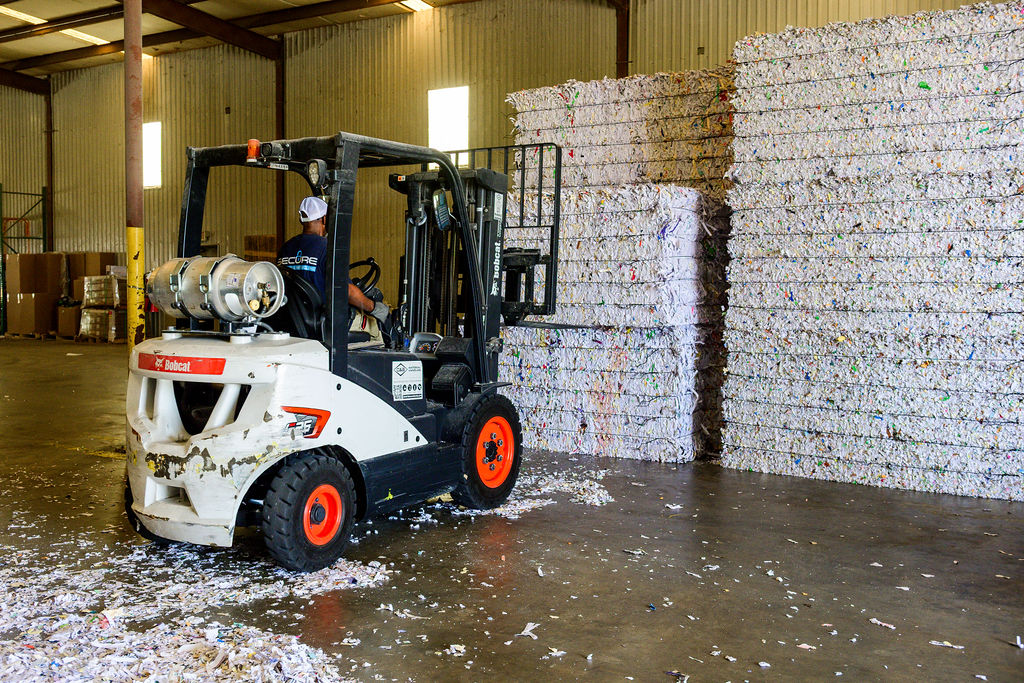
Eco-friendly shredding combines secure document destruction with responsible paper recycling. Confidential records are protected throughout collection and destruction, then the shredded material is processed for recycling after the information has been rendered unreadable.
This distinction matters. Businesses should not have to choose between protecting confidential information and recycling paper.
Placing intact documents directly into an office recycling bin may be environmentally well-intentioned, but it can leave customer, employee, financial, or proprietary information accessible before the paper reaches a recycling facility. Secure shredding addresses that vulnerability by destroying the information first.
For businesses searching for secure paper shredding services, business paper shredding, mobile paper shredding, or onsite document shredding, the right provider can help incorporate both security and recycling into the same process.
How Does the Secure Shredding and Recycling Process Work?
A secure destruction program should protect confidential documents from the moment employees decide they are no longer needed through final destruction.
At Secure Shredding and E-recycling, businesses can choose services based on their document volume, security requirements, and preferred destruction method.
1. Confidential Documents Are Collected Securely
Businesses with ongoing shredding needs can use secure document containers throughout the workplace.
Instead of leaving confidential paperwork on desks or placing it in open recycling bins, employees have a designated location for documents awaiting destruction. This is particularly useful for offices that regularly handle customer records, financial information, medical information, employee records, or other sensitive documents.
Organizations can also schedule one-time shredding for file purges, office moves, records cleanouts, and other large projects.
2. Documents Are Destroyed Onsite or Off-Site
Businesses can choose between mobile and off-site document destruction.
With mobile paper shredding, our shredding equipment comes directly to the business. Documents are securely transferred for destruction onsite, giving organizations additional visibility into the process.
Off-site shredding provides another secure option. Documents are collected and transported through a controlled chain of custody before being destroyed at a secure facility.
The right approach depends on the organization. A company that values witnessing destruction may prefer onsite shredding, while another handling particularly large volumes may find off-site processing more practical.
3. Businesses Receive Documentation of Destruction
Once the service is complete, businesses receive a Certificate of Destruction documenting that their materials were professionally destroyed.
This documentation can become an important part of an organization’s records management and information security procedures, particularly when preparing for internal reviews or compliance audits.
4. Destroyed Paper Is Recycled
Secure destruction does not mean paper has to become landfill waste.
After documents have been shredded and the information is no longer readable, the paper is processed for recycling. The fibers can then be used to manufacture new paper products.
This allows businesses to securely dispose of confidential records while supporting waste-reduction and sustainability initiatives.
Mobile Shredding vs. Office Shredding
Businesses sometimes assume an office shredder is the more economical or environmentally responsible option. That comparison changes when employee time, equipment, security, capacity, and recycling are considered.
| Business Consideration | Office Shredder | Professional Mobile Shredding |
|---|---|---|
| Handles large business volumes efficiently | No | Yes |
| Employees avoid manually shredding documents | No | Yes |
| Secure chain of custody | No | Yes |
| Onsite professional destruction available | No | Yes |
| Certificate of Destruction | No | Yes |
| Secure collection containers available | No | Yes |
| Designed for recurring business service | No | Yes |
| Paper processed for recycling after destruction | Varies | Yes |
| NAID AAA Certified process | No | Yes |
For businesses generating confidential paperwork regularly, outsourcing destruction can reduce the time employees spend feeding documents through small office machines while creating a more consistent disposal process.
Sustainability Should Include Electronics, Too
Paper is only one part of modern business waste.
Organizations routinely replace computers, laptops, servers, hard drives, networking equipment, phones, tablets, printers, and other electronics. When that equipment reaches the end of its useful life, businesses face two concerns: what happens to the physical equipment and what happens to the data stored on it?
Simply deleting files before disposing of a computer may not provide the level of protection an organization requires. Old data-bearing devices can continue to contain confidential information after they have been removed from daily use.
Secure Shredding and E-recycling provides hard drive destruction to help businesses permanently address data stored on retired media. Once appropriate data destruction has occurred, recyclable electronic materials can move through the electronics recycling process.
A comprehensive sustainability program should therefore consider both sides of an organization’s waste stream: confidential paper and retired electronics.
What Business Materials Need Secure End-of-Life Management?
A helpful way to build a sustainable information disposal program is to identify the materials your business regularly retires and determine the appropriate process for each.
| Business Material | Potential Concern | Recommended Solution |
|---|---|---|
| Customer and client files | Confidential information | Secure paper shredding |
| Employee and HR records | PII and employment information | Secure paper shredding |
| Financial records | Account and transaction data | Secure document destruction |
| Medical records | Protected health information | Secure shredding |
| Large archived file collections | Security + storage space | Bulk/purge shredding |
| Hard drives and SSDs | Recoverable digital data | Hard drive destruction |
| Retired computers and servers | Stored data + electronic waste | Data destruction + electronics recycling |
| Other outdated business electronics | Storage and waste concerns | Electronics recycling |
This approach is particularly valuable for businesses undergoing an office relocation, technology refresh, file room cleanout, merger, facility closure, or company-wide records purge. Instead of treating paper and IT equipment as unrelated disposal projects, organizations can build a coordinated information disposition strategy.
Why NAID AAA Certification Matters
Environmental responsibility should never come at the expense of information security.
Secure Shredding and E-recycling is NAID AAA Certified, demonstrating adherence to audited information-destruction standards covering areas such as operational security, employee screening, chain of custody, and destruction procedures.
Certification provides businesses with an independent standard to consider when comparing shredding companies and data destruction providers.
This is especially relevant for organizations responsible for information governed by privacy and security requirements.
HIPAA
Healthcare organizations and other covered entities must protect protected health information throughout its lifecycle. When paper records or data-bearing media are no longer required, secure disposal should be incorporated into the organization’s information management procedures.
FACTA
FACTA’s Disposal Rule addresses the proper disposal of consumer information. Businesses handling covered information should have procedures designed to prevent unauthorized access during disposal.
GLBA
Financial institutions subject to the Gramm-Leach-Bliley Act must safeguard customer information. Secure document and media destruction can play an important role when protected information reaches the end of its required retention period.
Professional shredding alone does not make an organization compliant with every applicable regulation. However, a documented destruction process, secure chain of custody, trained personnel, and Certificate of Destruction can support a stronger compliance program.
Who Benefits From Eco-Friendly Shredding and Electronics Recycling?
Virtually any organization that handles confidential information can benefit from a secure disposal program, but it is particularly important for businesses in information-intensive industries.
Secure Shredding and E-recycling works with organizations such as:
- Healthcare and medical facilities
- Law firms
- Financial institutions
- Government agencies
- Schools and universities
- Corporate offices
- Small businesses
A medical office may need recurring shredding for patient-related paperwork and electronics recycling when computers are replaced. A law firm may need an annual purge of closed files. A financial institution may need secure containers throughout its offices and documented recurring destruction.
The service should fit the organization’s workflow rather than forcing every business into the same disposal schedule.
One-Time or Ongoing Shredding: Which Is More Sustainable?
Both can be appropriate. The better choice depends on how your organization generates paper.
One-time or purge shredding works well for organizations with accumulated records that need to be destroyed all at once. Common examples include annual file cleanouts, office relocations, retention-schedule purges, and large digitization projects.
Ongoing shredding is designed for organizations that generate confidential paperwork continuously. Secure collection containers remain onsite, and documents are collected according to an established service schedule.
For many businesses, the most effective program actually uses both. Recurring service manages everyday confidential paperwork, while occasional bulk shredding handles unusually large volumes of archived records.
Building a More Sustainable Information Destruction Program
Businesses do not need to overhaul their entire operation to improve secure disposal practices. A good starting point is reviewing what happens to information after employees no longer need it.
Ask whether confidential paper goes into a locked container or an open recycling bin. Determine how long retired computers and hard drives remain in storage. Review whether employees know what should be securely destroyed. Consider whether destruction is documented and whether recyclable materials are being responsibly processed afterward.
From there, businesses can establish a program that combines secure containers, scheduled mobile shredding, one-time purge services, hard drive destruction, and electronics recycling as needed.
The result is a process that is easier for employees to follow and better aligned with both information-security and sustainability objectives.
Frequently Asked Questions About Eco-Friendly Business Shredding
Is shredded confidential paper recycled?
Yes. Secure Shredding and E-recycling processes shredded paper for recycling after confidential information has been securely destroyed. This allows businesses to recycle paper without placing intact sensitive records into unsecured recycling streams.
Is mobile paper shredding environmentally friendly?
Mobile paper shredding can support sustainability by securely destroying confidential documents and allowing the resulting paper to be recycled. It also gives businesses the convenience of having professional shredding equipment come directly to their location.
Can businesses recycle old computers that contain confidential information?
Yes, but data security should be addressed before or as part of the recycling process. Secure Shredding and E-recycling provides hard drive destruction and electronics recycling so businesses can securely retire data-bearing equipment while responsibly processing recyclable materials.
What is the difference between paper recycling and secure paper shredding?
Traditional recycling focuses primarily on recovering materials, while secure paper shredding focuses first on protecting the confidential information contained on the paper. Professional shredding combines both objectives by securely destroying documents before the material enters the recycling process.
Why should businesses use a NAID AAA Certified shredding company?
NAID AAA Certification provides an independently audited standard for information destruction practices. It evaluates security procedures such as employee screening, operational controls, chain of custody, and destruction processes, giving businesses another way to evaluate potential shredding providers.
Make Security Part of Your Sustainability Strategy
Sustainable business practices should protect more than natural resources. They should also protect the customers, employees, patients, and organizations whose information businesses are trusted to handle.
Secure Shredding and E-recycling brings those responsibilities together through mobile paper shredding, secure document destruction, ongoing and one-time shredding, hard drive destruction, and electronics recycling.
Whether your organization needs recurring document collection, a large file purge, secure destruction of retired hard drives, or a responsible solution for outdated electronics, our team can help build a program around your business’s actual needs.
Call Us Today! 1-(833) 747-3399
Or contact Secure Shredding and E-recycling online to request a quote for secure shredding and electronics recycling services.