Why Do-It-Yourself Shredding Isn’t Enough for Tax Documents
Tax season creates a perfect storm for sensitive business information. Accounting firms, financial professionals, corporate offices, healthcare organizations, nonprofits, and other businesses may handle large volumes of tax returns, W-2s, 1099s, payroll records, bank statements, employee files, invoices, and supporting documentation.
Much of that information exists in two places: on paper and on electronic devices.
That is why secure tax document disposal should go beyond an office shredder. Businesses need a complete information destruction strategy that addresses paper document shredding, hard drive destruction, electronics recycling, and IT asset disposition (ITAD).
Secure Shredding and E-recycling helps businesses securely manage information throughout its lifecycle with professional shredding and electronics recycling services backed by documented processes and NAID AAA Certification.
Why DIY Office Shredding Can Create Business Risk
A small office shredder may work for an occasional sheet of paper, but it is rarely an efficient solution for a business managing hundreds or thousands of confidential records.
The problem is not simply whether a document eventually gets shredded. Businesses also need to consider who has access to it, where it is stored before destruction, how destruction is documented, and what happens to the resulting material.
DIY shredding can create several challenges:
- Employees spend valuable work hours feeding documents through small shredders.
- Documents may accumulate beside the shredder while employees wait to destroy them.
- Standard trash or recycling bins can leave confidential information accessible.
- Consumer and office shredders may not be practical for large-volume purges.
- Internal destruction may provide little documentation for compliance or audit purposes.
- Employees may make inconsistent decisions about what should or should not be shredded.
- DIY paper shredding does nothing to address sensitive information stored on retired computers, hard drives, and other electronics.
A professional information destruction program creates a repeatable process instead.
Sensitive records enter a secure collection process. Authorized personnel handle the material. Documents or media are securely destroyed. The organization receives documentation of destruction.
That is a stronger approach for businesses handling confidential tax, financial, employee, customer, or patient information.
Tax Documents Contain Information Businesses Cannot Afford to Expose
Tax-related records can contain some of an organization’s most sensitive information.
Common examples include:
- Social Security numbers
- Employee identification information
- W-2 and 1099 forms
- Bank account information
- Payroll records
- Customer information
- Tax identification numbers
- Credit and payment information
- Financial statements
- Business income and expense records
- Addresses and contact information
- Copies of identification documents
This information can create opportunities for identity theft, fraud, and other misuse if records are improperly discarded.
The Federal Trade Commission’s FACTA Disposal Rule, for example, requires businesses covered by the rule to take appropriate measures when disposing of consumer-report information. The FTC specifically identifies methods such as burning, pulverizing, or shredding papers so information cannot practicably be read or reconstructed.
For businesses, secure destruction should therefore be considered part of information security—not simply office cleanup.
How Long Should Businesses Keep Tax Records?
Knowing when to shred tax documents is just as important as knowing how to shred them.
The IRS generally recommends keeping records that support income, deductions, or credits until the applicable period of limitations expires. In many situations that period is three years, but longer retention periods can apply depending on the circumstances.
Rather than applying one retention period to every record, businesses should establish a formal retention schedule based on applicable tax, legal, regulatory, contractual, and operational requirements.
Here is a simplified framework:
| Record or Asset | Business Consideration | End-of-Life Action |
|---|---|---|
| Tax returns and supporting records | Follow applicable IRS retention requirements | Secure paper shredding |
| W-2s, 1099s and payroll documents | Follow tax and employment retention requirements | Secure paper shredding |
| Customer financial records | Follow applicable legal and business requirements | Secure paper shredding |
| Everyday confidential paperwork | Retain only as required | Scheduled shredding |
| Old computers and laptops | Evaluate data and remaining asset value | ITAD or electronics recycling |
| Hard drives and storage media | Address confidential stored data | Data sanitization or physical destruction |
| Reusable IT equipment | Protect data before reuse or resale | IT asset disposition |
| Obsolete electronics | Securely address data, then recycle | Electronics recycling |
Important: A shredding provider should not determine your organization’s legal retention schedule. Your legal, accounting, tax, records-management, or compliance professionals should determine when records are eligible for destruction.
Once that decision has been made, Secure Shredding and E-recycling can help ensure those records are securely destroyed.
Mobile Paper Shredding Makes Tax Document Destruction Easier
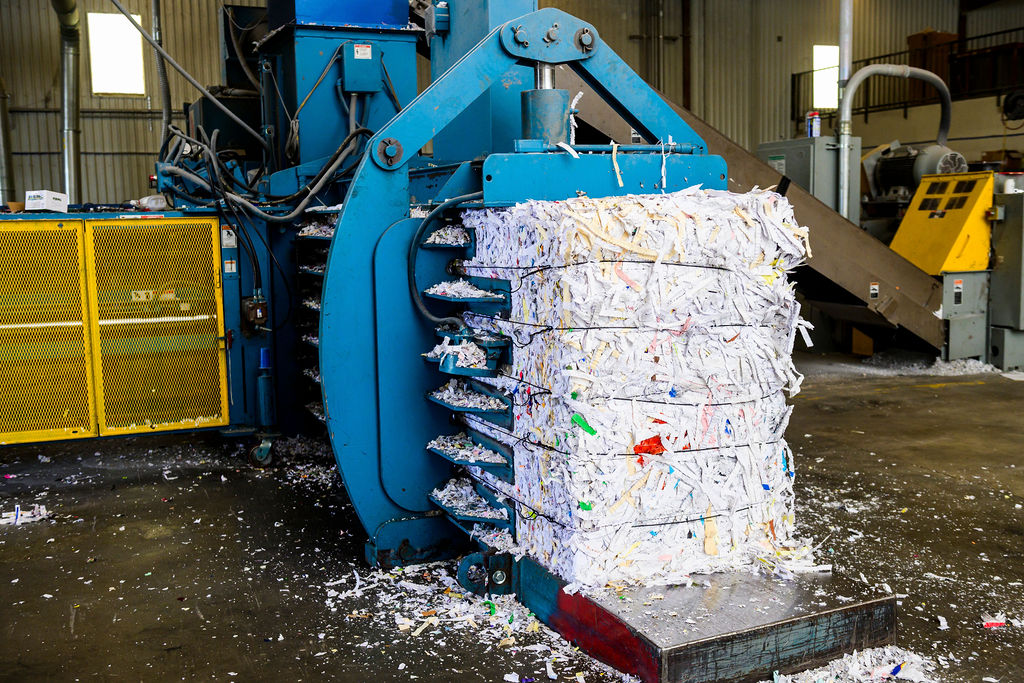
For businesses with large quantities of tax and financial records, mobile paper shredding eliminates much of the work associated with DIY shredding.
Instead of asking employees to spend hours feeding documents into an office shredder, a professional mobile shredding truck comes directly to your business.
The process is straightforward:
Your business collects confidential records securely → our trained team services your location → documents are destroyed onsite → shredded paper enters the recycling stream → you receive documentation of destruction.
Mobile shredding is particularly valuable for:
- Accounting and CPA firms
- Financial institutions
- Corporate offices
- Healthcare organizations
- Law firms
- Government agencies
- Schools and universities
- Insurance offices
- Payroll and HR departments
- Small and midsize businesses
Businesses that only accumulate records periodically can also use one-time shredding for tax-season cleanouts, annual record purges, office relocations, storage-room cleanouts, or other large destruction projects.
Scheduled Shredding Creates a Better Everyday Process
Tax season may expose a larger records-management problem: What happens to confidential documents throughout the rest of the year?
If employees have to decide whether each piece of paper belongs in a trash can, recycling bin, or office shredder, mistakes become easier to make.
Ongoing shredding services create a simpler workflow.
Secure, locked shredding containers can be placed throughout the workplace. Employees deposit confidential documents into the containers, and Secure Shredding and E-recycling services them according to a scheduled frequency.
This approach can reduce unnecessary employee handling while creating a consistent process for confidential information.
For businesses generating sensitive records every day, scheduled shredding turns document destruction from an occasional task into an established information-security practice.
Tax Data Doesn’t Disappear When You Replace a Computer
Paper is only half of the tax-data equation.
Accounting records, payroll files, scanned tax documents, spreadsheets, customer records, invoices, financial statements, and other sensitive information are routinely stored electronically.
That means an old computer can contain years of information even after employees stop using it.
Businesses should pay particular attention to:
- Hard disk drives
- Solid-state drives
- Desktop computers
- Laptops
- Servers
- External drives
- Backup media
- Tablets
- Mobile devices
- Printers and multifunction devices
- Other data-bearing electronics
Deleting files or moving them to the recycling bin on a computer should not be confused with securely destroying the underlying data.
When technology reaches the end of its useful life, businesses need an IT asset disposition strategy that considers both data security and the physical device.
Hard Drive Destruction Protects Data Stored on Retired Equipment
For storage media that does not need to be reused, hard drive destruction provides a physical method of rendering the device unusable.
This is particularly important for organizations replacing computers after tax season, upgrading servers, closing offices, consolidating facilities, or clearing years of obsolete technology from storage.
Secure Shredding and E-recycling can provide serialized hard drive tracking upon request, giving organizations additional documentation for data-bearing assets moving through the destruction process.
For businesses subject to internal security requirements or regulatory obligations, that documentation can become an important part of the chain of custody.
Electronics Recycling Should Be Part of the Same Conversation
Once sensitive data has been appropriately addressed, businesses still have to determine what happens to the equipment itself.
That is where electronics recycling becomes important.
The world generated approximately 62 million metric tons of e-waste in 2022, yet only 22.3% was documented as formally collected and recycled in an environmentally sound manner, according to the Global E-waste Monitor 2024.
The report projects global e-waste generation could reach 82 million metric tons by 2030.
For businesses, those statistics highlight why old electronics should not simply accumulate in a storage room or enter an ordinary waste stream.
A secure electronics recycling program helps organizations address two priorities simultaneously:
Protect the data. Responsibly manage the device.
That combination is particularly important for businesses handling financial, tax, healthcare, customer, or employee information.
ITAD Can Help Businesses Recover Value From Retired Technology
Not every computer reaching the end of its life within your organization is worthless.
Some laptops, desktops, servers, networking equipment, and other technology may still have resale or reuse value.
IT asset disposition and remarketing provides another option.
Depending on the equipment and your organization’s requirements, an ITAD program can incorporate asset evaluation, data sanitization or destruction, equipment testing, refurbishment, remarketing, recycling, and reporting.
This creates an important distinction:
Data-bearing device + no remaining useful value → secure destruction and electronics recycling.
Data-bearing device + potential remaining value → secure ITAD and potential remarketing.
For businesses replacing equipment across multiple offices or completing large technology refreshes, ITAD can turn an information-security obligation into an opportunity to recover residual asset value.
Paper Shredding and ITAD Work Better Together
A tax-season cleanout often uncovers both paper and technology.
A records room may contain 50 boxes of old tax documents. An IT closet down the hall may contain 25 computers and a stack of retired hard drives.
Those are not two unrelated problems. They are two forms of the same problem: sensitive information has reached the end of its useful lifecycle.
| Business Need | Paper Solution | Electronic Solution |
|---|---|---|
| Routine confidential information | Scheduled mobile shredding | Ongoing IT asset management |
| Annual tax-season cleanup | One-time paper shredding | Electronics recycling |
| Sensitive data destruction | Secure document destruction | Hard drive/media destruction |
| Office relocation | Bulk shredding | ITAD and electronics recycling |
| Compliance documentation | Certificate of Destruction | Asset/destruction reporting |
| Sustainability | Shredded-paper recycling | Responsible electronics recycling |
| Asset value recovery | N/A | IT asset remarketing |
Working with one provider for business document shredding, electronics recycling, data destruction, and ITAD can also simplify vendor management and help establish more consistent processes across departments.
NAID AAA Certification Provides Independent Assurance
When a third party handles confidential tax documents or data-bearing devices, trust should be based on more than a promise.
Secure Shredding and E-recycling is NAID AAA Certified for secure information destruction.
The NAID AAA Certification Program is administered by i-SIGMA and uses scheduled and unannounced audits to verify that certified companies meet defined requirements for secure information destruction.
Certification requirements address areas such as operational security, employee screening, written policies and procedures, access controls, and destruction processes.
For businesses evaluating a shredding or data-destruction vendor, independent certification provides an important layer of due diligence.
Understanding HIPAA, FACTA and GLBA
Different businesses have different regulatory obligations, but several major federal requirements demonstrate why information security must extend through disposal.
HIPAA
Healthcare organizations and business associates handling protected health information must maintain appropriate safeguards for PHI. HHS specifically recognizes shredding paper and appropriately clearing, purging, or destroying electronic media as methods for disposing of PHI.
FACTA
The Fair and Accurate Credit Transactions Act (FACTA) Disposal Rule applies to businesses and individuals that use consumer reports for business purposes. The FTC states that covered information should be disposed of using reasonable measures designed to protect against unauthorized access or use.
GLBA
The Gramm-Leach-Bliley Act (GLBA) Safeguards Rule requires covered financial institutions to develop, implement, and maintain an information-security program designed to protect customer information.
These requirements will not apply identically to every organization. However, they reinforce a common principle:
Businesses that collect sensitive information also have a responsibility to protect that information when it is no longer needed.
Professional Information Destruction Is About More Than Shredding Paper
A modern destruction program should follow information rather than format.
If information is printed, protect the paper.
If information is stored on a hard drive, protect the drive.
If the device has reached end of life, determine whether it should be destroyed, recycled, or securely remarketed.
Secure Shredding and E-recycling provides businesses with a single resource for:
- Mobile paper shredding
- One-time document shredding
- Scheduled shredding
- Secure shredding containers
- Hard drive destruction
- Electronics recycling
- IT asset disposition
- IT asset remarketing
- Certificates of Destruction
- Serialized tracking options for data-bearing devices
This combined approach helps accounting firms and businesses manage confidential information from the filing cabinet to the IT room.
Frequently Asked Questions About Business Shredding and Electronics Recycling
Is an office shredder secure enough for business tax documents?
An office shredder may work for occasional documents, but it can become inefficient and difficult to manage at business scale. Professional mobile paper shredding provides businesses with a structured destruction process, secure handling, bulk capacity, and documentation such as a Certificate of Destruction.
What is the best shredding service for an accounting firm or business during tax season?
Businesses with a large annual accumulation of records may benefit from one-time or purge shredding, while organizations generating confidential paperwork throughout the year may benefit from scheduled mobile shredding with secure containers. The appropriate service depends on record volume, security requirements, location, and frequency.
Can Secure Shredding and E-recycling destroy hard drives and recycle old business computers?
Yes. Secure Shredding and E-recycling provides hard drive destruction, electronics recycling, IT asset disposition, and IT asset remarketing in addition to professional paper shredding. This allows businesses to address confidential information stored in both physical and electronic formats.
What is the difference between electronics recycling and IT asset disposition?
Electronics recycling focuses primarily on responsibly processing end-of-life electronic equipment. IT asset disposition (ITAD) takes a broader lifecycle approach and may include inventory, data sanitization or destruction, testing, reuse, remarketing, recycling, and reporting. Equipment with remaining value may qualify for remarketing rather than immediate recycling.
How can businesses securely dispose of tax records while supporting HIPAA, FACTA or GLBA compliance?
Businesses should first establish appropriate record-retention policies and determine which regulations apply to them. Once records are eligible for destruction, a NAID AAA Certified information destruction provider can help establish secure processes for paper records and electronic media, including mobile shredding, hard drive destruction, electronics recycling, documentation, and chain-of-custody procedures.
Make Tax Season a Data-Security Checkup
Tax season is a natural time to clean out old files, but businesses should look beyond the filing cabinet.
What is sitting in your records room? What is sitting in your IT closet?
Boxes of expired tax documents may need secure paper shredding. Retired computers may need electronics recycling or ITAD. Old hard drives may require physical destruction. Reusable technology may still have remarketing value.
Secure Shredding and E-recycling can help your organization build a more complete process for both.
Whether you need a one-time tax document purge, recurring mobile paper shredding, hard drive destruction, business electronics recycling, or IT asset disposition services, our team can help determine the right solution for your organization.
Call Us Today! 1-(833) 747-3399