Why Medical Document Destruction and Secure IT Asset Disposition Matter for Healthcare Providers
Healthcare organizations are responsible for protecting sensitive information in more places than ever before. Patient data may live in a paper chart, on a physician’s laptop, inside a server, on a hard drive removed from an old workstation, or even within a retired printer or copier.
That means a secure disposal program cannot focus on paper alone.
Healthcare providers need a plan for both medical document shredding and end-of-life technology. Secure Shredding and E-recycling helps hospitals, clinics, physician practices, dental offices, healthcare networks, laboratories, and other medical organizations manage both sides of that responsibility through mobile paper shredding, hard drive destruction, electronics recycling, and IT asset disposition (ITAD) services.
For healthcare leaders, the goal is not simply to “get rid of” old records or equipment. It is to ensure that confidential information remains protected through the final stage of its lifecycle.
Why Healthcare Information Destruction Deserves More Attention
Healthcare remains one of the most heavily targeted industries for data theft. Verizon’s 2025 Data Breach Investigations Report analyzed 1,710 security incidents in the healthcare sector, including 1,542 incidents with confirmed data disclosure. Medical information was involved in 45% of those confirmed breaches, while personal information appeared in 40%.
Cybersecurity receives much of the attention, but information security also includes what happens to physical records and retired technology.
A medical record left in an open recycling bin can expose information. So can an old computer stored indefinitely in a back room with its hard drive still intact.
A complete healthcare data-disposal strategy should therefore answer two questions:
- How will confidential paper records be securely destroyed?
- How will data-bearing electronics be securely retired, destroyed, recycled, or remarketed?
Secure Shredding and E-recycling provides services for both. Our healthcare program includes NAID AAA Certified medical document destruction, secure containers, one-time and recurring shredding, and responsible processing of shredded paper and electronics.
HIPAA Applies to Paper and Electronic PHI
HIPAA requires covered entities to apply appropriate safeguards when disposing of protected health information.
The U.S. Department of Health and Human Services specifically identifies shredding, burning, pulping, or pulverizing paper records as examples of disposal methods that can make PHI unreadable and unreconstructable. For electronic media, HHS identifies methods such as clearing, purging, or physically destroying the media.
HHS also makes an important point about ordinary trash and recycling bins: PHI generally should not be placed into receptacles accessible to the public or unauthorized individuals unless the information has first been rendered unreadable and unable to be reconstructed.
For healthcare organizations, that makes secure disposal an operational issue as much as a compliance issue.
Employees need a clear process for documents they no longer need, and IT teams need an equally clear process for devices being removed from service.
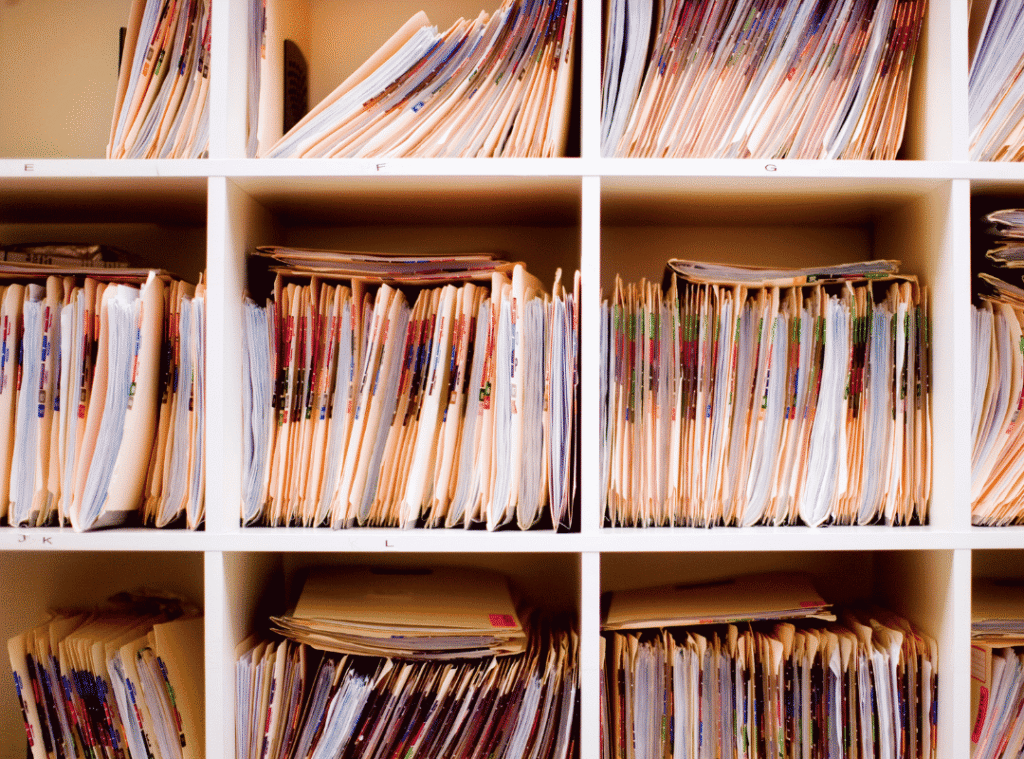
Paper Records Still Require a Secure Destruction Program
Electronic health records have reduced some paper use, but healthcare organizations still generate significant amounts of physical documentation.
Common examples include:
- Patient intake forms
- Insurance documents
- Billing records
- Prescription information
- Laboratory records
- Printed medical histories
- Employee records
- Payroll documents
- Internal reports
- Correspondence
- Copies of identification
- Financial information
Once those records reach the end of the appropriate retention period, they should not simply move from a filing cabinet into a regular trash or recycling bin.
Secure paper shredding services give healthcare facilities a controlled process for destroying those documents.
Mobile Paper Shredding for Healthcare Facilities
For many healthcare providers, mobile shredding is an effective way to handle medical records because destruction takes place at the facility.
Our mobile shredding trucks come directly to your location, allowing confidential documents to be destroyed onsite rather than asking employees to transport boxes of sensitive records elsewhere.
Mobile paper shredding can be useful for:
- Hospitals
- Physician practices
- Dental offices
- Urgent care centers
- Specialty practices
- Medical billing offices
- Diagnostic laboratories
- Assisted living and long-term care facilities
- Healthcare administrative offices
Healthcare organizations that generate confidential documents continuously can also combine mobile service with ongoing shredding and secure collection containers.
Employees place sensitive paperwork into locked containers as part of their normal workflow. Secure Shredding and E-recycling then services those containers at the agreed frequency.
That approach removes much of the uncertainty from everyday document disposal.
One-Time Medical Record Purges
Not every healthcare provider needs recurring service.
A practice may need to destroy a large archive after completing a records-retention review, relocating an office, consolidating facilities, or digitizing older files.
One-time shredding gives healthcare organizations a way to securely process larger quantities of records without committing to an ongoing schedule.
Instead of assigning employees to spend days using small office shredders, professional bulk destruction can handle the project more efficiently while maintaining a controlled chain of custody.
Paper Is Only Half of the Healthcare Data-Disposal Problem
A healthcare organization may have excellent procedures for destroying medical charts while dozens of old computers sit untouched in an IT storage room.
That creates a different kind of risk.
Hospitals and medical practices regularly retire:
- Desktop computers
- Laptops
- Servers
- Hard drives
- Solid-state drives
- Tablets
- Mobile devices
- Printers
- Copiers
- Networking equipment
- Backup media
- Other data-bearing electronics
Simply deleting a file does not physically destroy the storage media that held it.
HHS requires covered entities to maintain policies and procedures addressing the final disposition of electronic PHI and the hardware or electronic media on which it is stored.
That is why hard drive destruction, electronics recycling, and IT asset disposition should be treated with the same importance as medical document shredding.
Hard Drive Destruction for Electronic PHI
Hard drive destruction provides a physical end-of-life option for drives containing sensitive healthcare information.
For devices that no longer need to remain functional, physically destroying the storage media can remove the possibility that an old hard drive will later be reused, resold, misplaced, or accessed without authorization.
This can be especially important during:
- Computer refresh projects
- Server upgrades
- Facility closures
- Mergers and acquisitions
- Office relocations
- Large IT cleanouts
- Equipment lease returns
- Data-center upgrades
Healthcare providers should know not only where a retired device went, but also what happened to the data stored on it.
Electronics Recycling for Healthcare Organizations
Once data security has been addressed, healthcare organizations still need a responsible destination for the physical equipment.
Electronics recycling helps businesses securely process retired computers and other technology while recovering useful materials.
The scale of the global e-waste problem makes responsible processing increasingly important. The Global E-waste Monitor reported that 62 million metric tons of e-waste were generated worldwide in 2022, yet only 22.3% was documented as formally collected and recycled in an environmentally sound manner.
Electronic equipment also contains materials worth recovering. The EPA cites estimates that recycling one million laptops can save energy equivalent to the annual electricity use of more than 3,500 U.S. homes. Recycling one million cell phones can recover approximately 35,000 pounds of copper, 772 pounds of silver, 75 pounds of gold, and 33 pounds of palladium.
For healthcare organizations pursuing sustainability initiatives, secure electronics recycling can support environmental goals without ignoring data security.
IT Asset Disposition Gives Healthcare Organizations More Options
Not every retired device needs to be destroyed.
Some IT assets still have usable life and potential resale value. This is where IT asset disposition, or ITAD, becomes important.
Secure Shredding and E-recycling provides IT asset remarketing and ITAD services for equipment that may be suitable for reuse or resale.
Our ITAD process can include:
- Asset evaluation
- Secure data sanitization or physical destruction
- Equipment testing and refurbishment
- Removal of identifying labels and asset tags
- Remarketing through reseller and broker networks
- Final reporting and payment
For qualifying equipment, remarketing can allow a healthcare organization to recover value instead of automatically sending every retired asset into the recycling stream. Secure Shredding and E-recycling also provides tracking and documentation for processed equipment.
That makes ITAD especially relevant for larger hospital systems, healthcare networks, and organizations replacing technology at scale.
Paper Shredding, Electronics Recycling and ITAD at a Glance
| Healthcare Asset | Primary Risk | Recommended Service |
|---|---|---|
| Patient paper records | Exposure of PHI | Secure paper shredding |
| Daily confidential paperwork | Improper disposal | Secure containers + ongoing shredding |
| Archived medical records | Large-volume exposure | One-time/bulk shredding |
| Hard drives and SSDs | Recoverable electronic data | Hard drive destruction |
| Retired computers | Data + equipment disposal | ITAD or electronics recycling |
| Reusable laptops and workstations | Data + lost residual value | Secure IT asset remarketing |
| Servers and networking equipment | High-value institutional data | Data destruction + ITAD/electronics recycling |
| Printers and copiers | Potential stored information | Secure electronics processing |
| Backup media | Stored PHI | Secure media destruction |
The important distinction is that paper, data-bearing media, and reusable technology may require different end-of-life processes, but they should all be managed under the same information-security mindset.
Why NAID AAA Certification Matters in Healthcare
Healthcare providers should carefully evaluate any company that handles confidential records or data-bearing media.
Secure Shredding and E-recycling is NAID AAA Certified, which provides independent oversight of secure information-destruction practices. Our healthcare services include secure collection, certified destruction, Certificates of Destruction, and responsible recycling.
NAID AAA Certification evaluates operational areas such as security procedures, employee screening and training, and information-destruction practices.
This is particularly useful when healthcare organizations are evaluating vendors that will become part of their chain of custody.
HIPAA Is Not the Only Regulation Healthcare Organizations May Encounter
HIPAA is the most obvious privacy regulation associated with healthcare, but it is not necessarily the only one relevant to an organization’s information-disposal program.
HIPAA
HIPAA applies to protected health information handled by covered entities and business associates. HHS expressly addresses secure disposal of both paper PHI and electronic media.
FACTA
The FACTA Disposal Rule applies to covered consumer-report information. The FTC identifies shredding paper and destroying or erasing electronic media so information cannot be read or reconstructed as examples of reasonable disposal measures.
GLBA
GLBA’s Safeguards Rule applies to covered financial institutions and requires measures designed to protect customer information. Healthcare organizations should determine whether any of their business activities fall within GLBA requirements and address those obligations as part of their broader information-security program.
Professional destruction services can support these compliance efforts, but each healthcare organization remains responsible for determining which laws, retention schedules, and internal requirements apply to its records and assets.
Why Secure Shredding and E-recycling Is Built for Healthcare Data
Healthcare organizations often have separate teams managing paper records, IT equipment, compliance, facilities, and sustainability.
Working with one provider across those functions can simplify the process.
Secure Shredding and E-recycling provides:
- NAID AAA Certified secure document destruction
- Mobile paper shredding
- Off-site shredding
- One-time medical record purges
- Ongoing scheduled shredding
- Secure collection containers
- Hard drive destruction
- Electronics recycling
- IT asset disposition
- IT asset remarketing
- Serialized equipment reporting
- Certificates of Destruction
Our healthcare-specific services support hospitals, clinics, physicians’ offices, treatment centers, dental practices, diagnostic laboratories, government healthcare organizations, and other medical facilities.
Secure Shredding and E-recycling also reports serving 5,000+ customers on its current market pages, providing another first-party indicator of the scale at which our team operates.
Building a Better Healthcare Information-Disposal Program
A strong program should make secure disposal easy for every department.
Medical records teams need a reliable way to handle expired paper files. Nurses and administrators need locked collection containers for everyday confidential paperwork. IT teams need a process for hard drives and retired equipment. Sustainability teams need assurance that recyclable materials are being responsibly processed.
Those functions should complement one another rather than operate in isolation.
A practical program might combine recurring mobile paper shredding for everyday records, annual purge shredding for archives, hard drive destruction for devices with sensitive data, electronics recycling for obsolete hardware, and ITAD for equipment that still has market value.
That gives healthcare organizations a more complete answer to the question, “What happens to our information when we no longer need the paper or device that holds it?”
Frequently Asked Questions
What is the safest way for a healthcare organization to dispose of old medical records?
Once applicable retention requirements have been satisfied, professional paper shredding is an established way to render PHI unreadable and unreconstructable. HHS specifically identifies shredding as an appropriate disposal method for paper records containing PHI.
Do healthcare providers need to destroy old hard drives?
Healthcare organizations should have policies addressing the final disposition of electronic PHI and the media or hardware on which it is stored. When a drive is no longer needed for reuse, physical hard drive destruction can provide a secure end-of-life option.
What is the difference between electronics recycling and IT asset disposition?
Electronics recycling focuses on responsibly processing obsolete electronic equipment and recovering recyclable materials. ITAD takes a broader approach to retired technology and may include asset tracking, data sanitization, testing, reuse, resale, remarketing, recycling, or destruction depending on the value and condition of each asset.
Can Secure Shredding and E-recycling handle both paper records and healthcare IT equipment?
Yes. Secure Shredding and E-recycling provides mobile and off-site paper shredding, hard drive destruction, electronics recycling, and IT asset disposition services, allowing healthcare organizations to manage both physical and electronic information through one provider.
Why should a healthcare provider choose a NAID AAA Certified destruction company?
NAID AAA Certification provides independent verification that an information-destruction company meets defined security and operational standards. For healthcare organizations trusting a vendor with PHI and other sensitive information, certification provides an additional layer of vendor due diligence.
Protect Patient Information From Paper Records to Retired IT Assets
Healthcare data protection should not end when a file is closed or a computer is replaced.
Paper records need a secure destruction process. Hard drives need an appropriate data-destruction strategy. Retired electronics need responsible processing. IT assets that still have useful life need secure disposition before they can be reused or resold.
Secure Shredding and E-recycling brings those services together so healthcare organizations can manage information security and sustainability across the full lifecycle of their records and technology.
Call Us Today! 1-(833) 747-3399
Contact Secure Shredding and E-recycling to request a quote for medical document shredding, electronics recycling, hard drive destruction, or IT asset disposition services.