How to Choose the Right Secure Document Containers for Your Business
Sensitive information needs to be protected long before it reaches the shredder. For businesses that regularly handle confidential paperwork, the days or weeks between an employee discarding a document and the next scheduled shredding service can create an unnecessary security gap.
Secure document containers help close that gap by giving employees a designated, locked place to dispose of sensitive paperwork as soon as it is no longer needed.
Secure Shredding and E-recycling provides lockable document containers for offices, healthcare facilities, financial institutions, law firms, government agencies, schools, universities, and other organizations that routinely handle confidential information.
When paired with mobile shredding or scheduled off-site destruction, these containers help businesses maintain a more secure chain of custody from the moment a document is discarded until it is professionally destroyed.
Why Do Businesses Need Secure Document Containers?
An open trash can or recycling bin may be convenient, but it is not an appropriate destination for confidential business records.
Documents waiting to be destroyed may contain:
- Customer information
- Employee records
- Financial statements
- Medical information
- Legal documents
- Tax records
- Account information
- Proprietary business information
Once an employee determines that a document is no longer needed, there should be a secure place to dispose of it immediately. A secure document container provides that designated location while limiting unauthorized access to the information inside.
For businesses using ongoing secure paper shredding services, strategically placed containers can also make following company security policies easier. Employees do not have to decide where sensitive documents belong or leave them sitting on a desk until shredding day. They simply place them in the locked container, where they remain protected until collection.
Which Secure Document Container Is Right for Your Business?
There is no single container that works best for every business. The right choice depends on where the container will be located, how much confidential paper your organization generates, how many employees need access to it, and how frequently shredding services are scheduled.
Larger organizations may benefit from using several container styles throughout the same facility. An Executive Console might make sense near reception, for example, while a records department may require a 96-gallon cart.
Executive Console: Secure Storage for Professional Offices
The Executive Console provides secure document collection without looking out of place in a professional office.
Its low-profile design makes it especially useful in areas where clients, patients, vendors, or other visitors may be present.
Features include:
- Tamper-resistant document deposit
- Lock-and-key security
- Professional office design
- 32-gallon capacity
- Approximately 90–100 pounds of paper capacity
Executive Consoles work particularly well in:
- Law firms
- Financial offices
- Healthcare facilities
- Administrative departments
- Human resources offices
- Reception areas
Businesses with recurring secure paper shredding services can position consoles throughout the office so employees always have a convenient place to dispose of confidential paperwork.
Where Should Secure Shredding Containers Be Placed?
Choosing the right container is only half of the equation. Businesses should also think carefully about placement.
A good starting point is to identify where confidential documents are most often created, printed, reviewed, and discarded.
Consider placing secure containers near:
- Printers and copiers
- Accounting departments
- Human resources offices
- Medical records departments
- Nurses’ stations
- Legal departments
- Customer service areas
- Executive offices
- File rooms
- Employee workstations
Employees should not have to walk across an entire building to securely dispose of a document. Placing containers close to the areas where sensitive information is regularly handled makes the secure option the convenient option.
Secure Containers vs. Open Recycling Bins
Businesses sometimes assume confidential paperwork can simply be placed into a regular recycling bin because the paper will eventually be recycled.
The problem is what can happen before it reaches the recycling facility.
| Security Feature | Secure Shredding Container | Open Recycling Bin |
|---|---|---|
| Locked against unauthorized access | Yes | No |
| Designed for confidential records | Yes | No |
| Supports controlled chain of custody | Yes | No |
| Integrates with scheduled shredding | Yes | No |
| Limits casual access to discarded records | Yes | No |
| Supports a documented destruction program | Yes | No |
Businesses do not have to choose between security and recycling. Confidential records can be securely destroyed first and the resulting paper recycled afterward.
Secure Containers Are Only One Part of the Chain of Custody
A locked container protects documents while they are waiting for destruction, but the security process should not end when the container is opened.
Secure Shredding and E-recycling offers both mobile shredding and off-site shredding options.
With mobile paper shredding, confidential documents are transferred from the secure container to the mobile shredding truck and destroyed onsite. Businesses can witness the destruction process, and a Certificate of Destruction provides documentation that the service was completed.
Organizations that generate confidential paperwork continuously can establish an ongoing scheduled shredding program. Businesses with less frequent needs can schedule one-time shredding for file room cleanouts, office relocations, annual purges, or other large projects.
Why NAID AAA Certification Matters
The security of a document destruction program ultimately depends on more than the container holding the documents. Businesses also need to know who will handle their information after collection.
Secure Shredding and E-recycling is NAID AAA Certified for secure information destruction. NAID AAA Certification establishes rigorous standards surrounding areas such as employee screening, operational security, chain of custody, destruction procedures, and ongoing audits.
These safeguards are especially important for organizations responsible for information regulated by privacy requirements such as HIPAA, FACTA, and GLBA.
HIPAA
Healthcare organizations must protect sensitive patient information throughout its lifecycle. Secure containers can help prevent discarded records containing protected health information from being left accessible while awaiting destruction.
FACTA
Businesses handling consumer information need appropriate disposal procedures to reduce the risk of unauthorized access and identity theft. Professional document destruction can become an important part of that process.
GLBA
Financial institutions and other covered organizations are responsible for safeguarding protected customer information, including information that has reached the end of its required retention period.
Secure containers alone do not create compliance, but they can make a well-designed information security policy much easier for employees to follow consistently.
Don’t Forget About Electronic Data
The same principle behind secure document containers applies to old electronics: information can remain vulnerable while equipment sits around waiting for disposal.
Businesses frequently accumulate outdated:
- Computers
- Laptops
- Servers
- Hard drives
- SSDs
- Tablets
- Cell phones
- Networking equipment
- Printers
- Other data-bearing electronics
An old laptop sitting forgotten in a storage room may contain just as much sensitive information as a box of paper records.
Secure Shredding and E-recycling provides hard drive destruction and electronics recycling alongside secure paper shredding, giving businesses a way to address both physical and electronic information when equipment or records reach the end of their useful life.
Instead of allowing outdated devices to pile up, businesses can establish procedures for securely collecting, processing, and recycling retired electronics while ensuring data-bearing components are handled appropriately.
What Does a Complete Secure Document Disposal Process Look Like?
A strong document destruction program should make it clear what employees are expected to do with confidential information once it is no longer needed.
In practice, the process can be straightforward. Employees place documents that have reached the end of their retention period into a locked container rather than an open trash or recycling bin. Secure Shredding and E-recycling then collects the documents according to the organization’s service schedule and securely destroys them through mobile or off-site shredding. A Certificate of Destruction provides a record of the completed service, and the destroyed paper is processed for recycling.
Electronic equipment requires a similar end-of-life plan. Retired computers, hard drives, servers, and other data-bearing devices should be collected securely rather than left indefinitely in storage. The data-bearing media can then be appropriately destroyed before the remaining materials move through the electronics recycling process.
Having clear procedures for both paper and electronics makes it easier for employees to know what to do and helps businesses reduce unnecessary information exposure.
Frequently Asked Questions About Secure Document Containers
What is a secure document container?
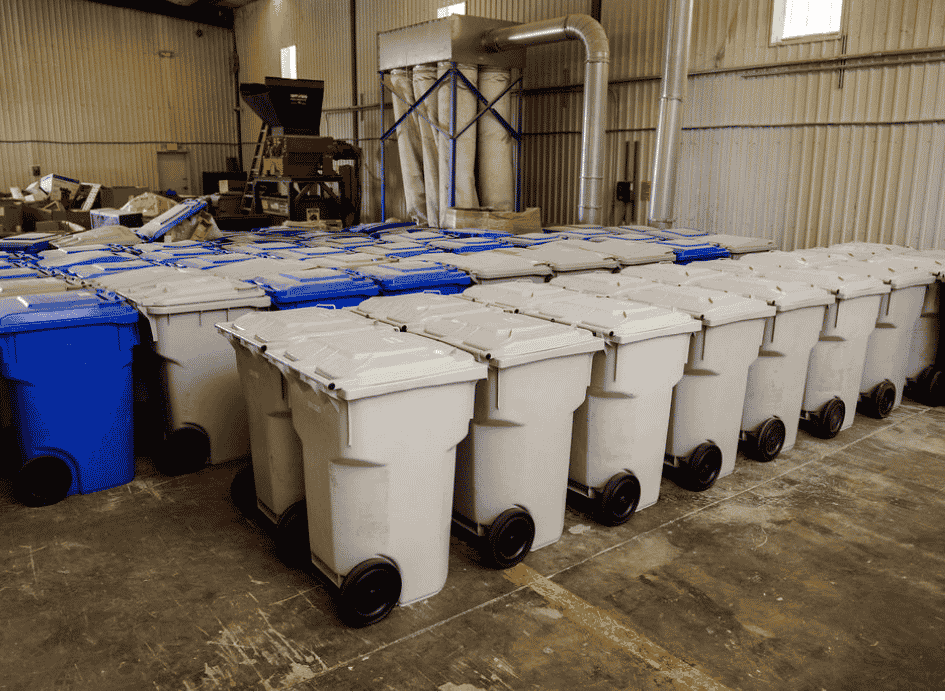
A secure document container is a locked console, bin, or cart designed to hold confidential paperwork until it can be professionally destroyed. It provides employees with a safer alternative to leaving sensitive records in open trash cans, recycling bins, or unsecured boxes.
What size secure shredding container does my business need?
The right size depends on how much paper your business generates, the number of employees using the container, available space, and how frequently shredding service occurs. Smaller consoles are often appropriate for individual departments, while 64- or 96-gallon carts work well in higher-volume environments.
Can secure containers be used with mobile paper shredding?
Yes. Secure containers are commonly paired with mobile paper shredding programs. Documents remain locked between service dates and are transferred for onsite destruction when the mobile shredding truck arrives.
Do secure shredding containers help with HIPAA, FACTA, and GLBA compliance?
Secure containers can support an organization’s compliance efforts by limiting access to confidential records awaiting destruction. They should be part of a broader information security program that also addresses retention schedules, employee procedures, chain of custody, and secure destruction.
Can Secure Shredding and E-recycling handle both paper documents and old electronics?
Yes. Secure Shredding and E-recycling provides secure paper shredding, hard drive destruction, and electronics recycling. Businesses can use these services to establish disposal procedures for both physical documents and retired technology.
Choose Secure Document Containers That Fit Your Business
The best secure document container is one that fits naturally into your workplace and makes it easy for employees to follow your information security procedures.
A small professional office may need strategically placed Executive Consoles, while a high-volume records department may be better served by 64- or 96-gallon carts. Larger organizations may benefit from using several container styles across different departments.
Secure Shredding and E-recycling can help determine the right combination of container sizes, placement, and service frequency based on your organization’s needs.
From secure containers and ongoing mobile paper shredding to one-time document purges, hard drive destruction, and electronics recycling, our team provides businesses with practical solutions for protecting information through the end of its lifecycle.
Call Us Today! 1-(833) 747-3399
Or request a quote from Secure Shredding and E-recycling to discuss secure document containers, mobile paper shredding, electronics recycling, and other secure destruction services for your business.