What Happens During a Mobile Shredding Service? A Step-by-Step Look at the Process
If your business has never scheduled a mobile shredding service, you may wonder what actually happens when the truck arrives.
The process is simple: confidential documents are securely collected, moved directly to the mobile shredding truck, destroyed at your location, and then recycled. Your business receives documentation confirming the service was completed.
For companies managing more than paper, Secure Shredding and E-recycling can also handle hard drives, retired electronics, and IT assets. That means one provider can help your business securely manage information from the filing cabinet to the IT closet.
Here’s what to expect.
Step 1: Secure Documents Before Your Shredding Service
The process starts before the shredding truck arrives.
Your business should first identify records that have reached the end of their approved retention period and are authorized for destruction. Depending on your organization, that might include:
- Employee and HR files
- Customer records
- Financial documents
- Medical records
- Contracts and legal files
- Payroll information
- Confidential correspondence
- Archived business records
Rather than placing these documents in regular trash or recycling, confidential paper should remain protected until it can be destroyed.
Businesses that generate sensitive documents every day can use secure collection containers and ongoing shredding services to establish a routine process.
Have years of records to clear out instead? One-time shredding is designed for larger purges and occasional cleanouts.
Step 2: The Mobile Shredding Truck Comes to You
With mobile paper shredding, your confidential documents don’t need to leave your location intact.
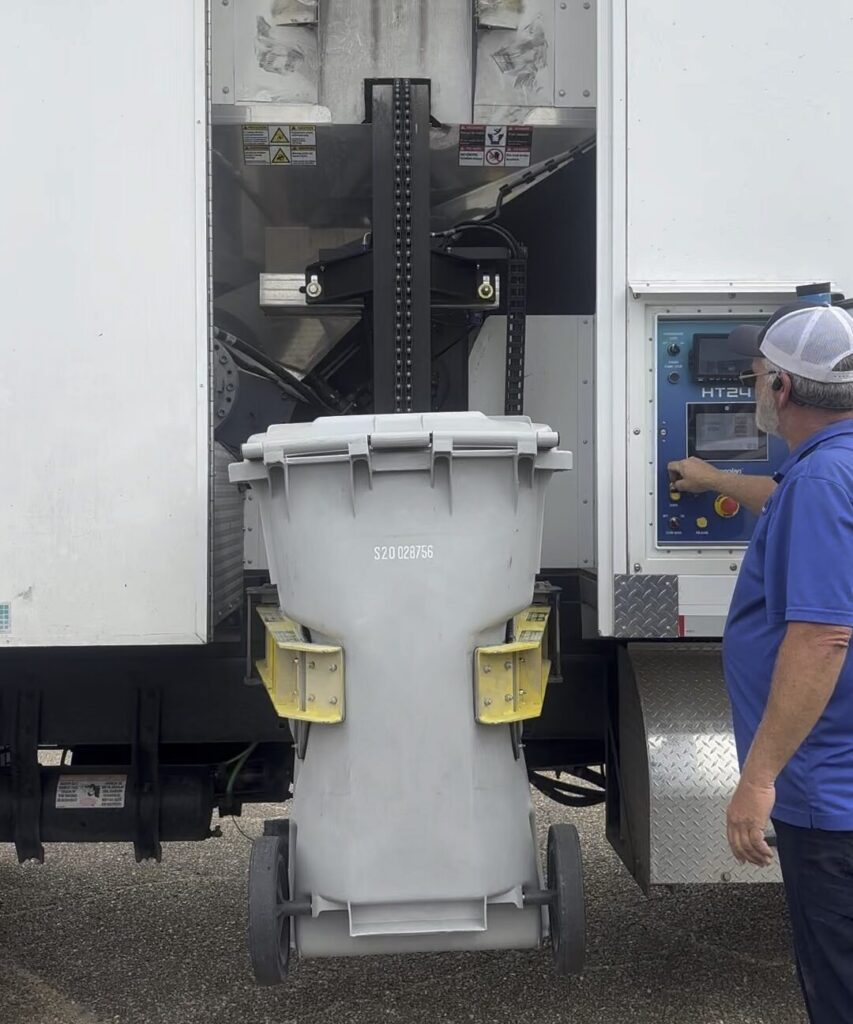
A trained technician arrives at your business, retrieves the materials approved for destruction, and moves them to the mobile shredding truck through a controlled chain of custody.
This makes onsite document shredding especially useful for businesses that handle sensitive information or have large quantities of paper to destroy.
Instead of asking employees to spend hours feeding documents into office shredders, your business can have boxes or secure containers of paper handled through a professional commercial shredding process.
Step 3: Your Documents Are Destroyed On-Site
Once the documents reach the truck, they are destroyed using commercial shredding equipment.
Because destruction takes place at your location, businesses can have greater visibility into the process. The documents are destroyed before the mobile shredding truck leaves the site.
That creates a straightforward chain:
Secure collection → controlled handling → onsite destruction
Mobile shredding can work well for healthcare practices, law firms, financial institutions, corporate offices, government agencies, schools, and other organizations that routinely manage confidential information.
Step 4: The Shredded Paper Is Recycled
Security and sustainability don’t have to compete.
Once the confidential information has been destroyed, the shredded paper is transported for recycling rather than being treated as ordinary waste.
The service therefore accomplishes two goals:
Sensitive information is securely destroyed.
The resulting paper is recycled for future use.
For businesses tracking environmental initiatives alongside information-security requirements, professional shredding can support both priorities.
The Mobile Shredding Process at a Glance
| Step | What Happens | Why It Matters |
|---|---|---|
| Secure | Confidential documents are protected before service | Limits unnecessary access |
| Collect | A technician retrieves approved materials | Maintains controlled handling |
| Destroy | Documents are shredded at your location | Makes information unreadable |
| Recycle | Shredded paper enters the recycling stream | Supports material recovery |
| Document | Service is recorded | Supports business records and audits |
What About Hard Drives, Computers and Other Electronics?
Paper isn’t the only place confidential business information lives.
Old laptops, desktops, servers, hard drives, and other devices may retain years of employee, customer, financial, or operational data. Sending that equipment directly to recycling without first addressing the data can leave sensitive information accessible.
Secure Shredding and E-recycling helps businesses manage both sides of the problem.
Hard Drive Destruction
When a hard drive no longer needs to remain usable, physical destruction can help make the stored information inaccessible.
For applicable projects, serial-number reporting provides additional documentation connecting individual drives with their destruction.
Business Electronics Recycling
Once data-security requirements have been addressed, obsolete computers and other equipment can move into an appropriate electronics recycling process.
The need is substantial. The Global E-waste Monitor 2024 reported that the world generated approximately 62 million metric tons of e-waste in 2022, but only 22.3% was documented as formally collected and recycled in an environmentally sound manner.
IT Asset Disposition
Not every retired computer needs to be recycled.
IT asset disposition (ITAD) can provide another path for laptops, desktops, servers, and other technology that may retain useful life or market value.
Depending on the project, ITAD can include asset tracking, secure data handling, testing, refurbishment, remarketing, recycling, and reporting.
Why NAID AAA Certification Matters
A shredding provider handles information your organization has a responsibility to protect. Businesses should therefore evaluate more than price and pickup availability.
Secure Shredding and E-recycling is NAID AAA Certified for secure information destruction.
Administered by i-SIGMA, NAID AAA Certification independently verifies security protocols that include secure processes, chain of custody, and employee background screening. Certified providers are also subject to ongoing audits.
Independent certification can provide an additional level of vendor due diligence for businesses managing sensitive information.
What About HIPAA, FACTA and GLBA?
Professional shredding and data destruction can also support information-disposal procedures for organizations subject to privacy and security regulations.
HIPAA: HHS requires covered entities to apply appropriate safeguards when disposing of protected health information. Shredding is one method HHS identifies for rendering paper PHI essentially unreadable and unable to be reconstructed.
FACTA: The FTC Disposal Rule requires covered organizations to take reasonable measures when disposing of certain consumer-report information. Shredding paper so information cannot be read or reconstructed is one method identified by the FTC.
GLBA: Covered financial institutions must maintain safeguards for customer information. The FTC’s Safeguards Rule guidance also addresses secure disposal as part of an organization’s broader information-security program.
NAID AAA Certification and professional destruction services can support compliance efforts, but they do not automatically make an organization compliant. Each business remains responsible for its own retention policies, safeguards, and regulatory requirements.
Documenting the Destruction
Secure destruction shouldn’t end with the last piece of paper going through the shredder.
Secure Shredding and E-recycling provides Certificates of Destruction for applicable services, giving businesses documentation that the destruction service was completed.
For applicable hard drive projects, serialized reporting can provide additional asset-level documentation.
These records can support internal audits, compliance reviews, vendor-management files, and records-management programs.
Frequently Asked Questions About Mobile Shredding
What happens during a mobile shredding service?
A technician collects the confidential documents approved for destruction and transfers them to the mobile shredding truck. The documents are destroyed at your location, and the shredded paper is subsequently transported for recycling.
Is mobile shredding good for large amounts of business records?
Yes. Mobile shredding is well suited to high-volume projects because commercial equipment can process large quantities of paper without requiring employees to use office shredders. Businesses can use it for one-time purges or recurring service.
Can mobile shredding support HIPAA, FACTA and GLBA requirements?
Professional document destruction can support an organization’s disposal procedures under HIPAA, FACTA, GLBA, and other requirements. The specific obligations depend on the organization, information, and applicable regulations.
Can Secure Shredding and E-recycling also take old business computers?
Yes. Secure Shredding and E-recycling provides hard drive destruction, business electronics recycling, and ITAD services in addition to paper shredding, allowing businesses to address both physical and electronic information.
What’s the difference between electronics recycling and ITAD?
Electronics recycling is generally appropriate for equipment that has reached the end of its useful life. ITAD can include secure data handling, asset tracking, testing, refurbishment, remarketing, recycling, and reporting for technology that may still have value.
Secure Your Paper and Your Technology
Mobile shredding gives businesses a straightforward way to securely destroy confidential paper without asking employees to manage the process themselves.
But modern information security doesn’t end at the filing cabinet.
Secure Shredding and E-recycling provides mobile paper shredding, commercial document destruction, hard drive destruction, electronics recycling, and ITAD services so businesses can securely manage information wherever it lives.
Whether you’re clearing a records room, establishing recurring shredding service, or retiring a fleet of computers, we can help you determine the right next step.
Contact Secure Shredding and E-recycling to request a quote.
Call Us Today! 1-(833) 747-3399