What Documents Should a Business Shred? A Guide by Industry
Every business handles information that shouldn’t end up in an ordinary trash or recycling bin. Employee files, financial records, customer information, contracts, and medical records can all contain sensitive data.
The same applies to old technology. Laptops, hard drives, servers, and other electronics may retain confidential information long after they’re no longer being used.
So, what should a business shred, destroy, or recycle? The answer depends on the information you handle and your industry.
What Business Documents Should Be Shredded?
Once applicable retention requirements have been met, businesses should consider securely destroying documents containing confidential, personal, financial, or proprietary information, including:
- Employee and HR records
- Payroll documents
- Customer and client files
- Financial and tax records
- Contracts and legal documents
- Medical information
- Insurance records
- Background checks
- Copies of identification
- Confidential correspondence
- Proprietary business information
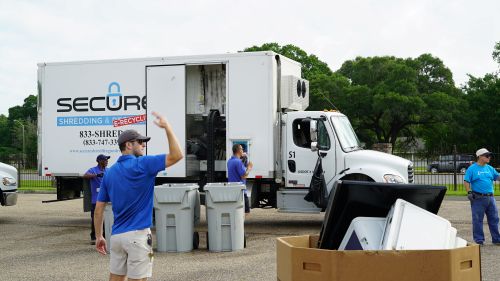
Businesses generating confidential paper regularly can use scheduled shredding and secure containers. Larger cleanouts may call for one-time shredding or mobile paper shredding.
Records should always be reviewed against applicable legal, regulatory, contractual, and internal retention requirements before destruction.
Healthcare: PHI, Medical Records and Electronics
Healthcare organizations may need to securely destroy:
- Patient records
- Medical histories
- Billing and insurance records
- Prescription information
- Lab reports
- Patient intake forms
- Employee health information
HIPAA requires covered entities to apply appropriate safeguards when disposing of protected health information. HHS recognizes shredding as an appropriate method for paper PHI when the information is rendered unreadable, indecipherable, and unable to be reconstructed.
Electronic PHI requires the same attention. Hard drives, computers, servers, and other electronic media can retain patient information and should be securely addressed before equipment leaves the organization’s control.
For healthcare organizations:
Paper PHI → secure shredding
Electronic PHI → secure data sanitization or destruction
Retired equipment → electronics recycling or ITAD
Financial Services: Customer Information and GLBA
Banks, lenders, financial advisors, and other covered financial institutions may handle:
- Account information
- Loan documents
- Credit applications
- Financial statements
- Tax records
- Customer identification
- Credit reports
The Gramm-Leach-Bliley Act (GLBA) requires covered financial institutions to safeguard customer information. The FTC’s Safeguards Rule guidance also addresses secure disposal as part of an organization’s information-security program.
That responsibility extends beyond paper. Retired laptops, hard drives, and servers may contain customer records, financial information, emails, or account data.
Financial organizations should consider commercial paper shredding, secure data destruction, electronics recycling, and ITAD as connected parts of the same information-security program.
HR Departments: Employee Records and FACTA
Nearly every industry has sensitive information sitting in HR.
Documents may include:
- Employment applications
- Background checks
- Payroll records
- Social Security information
- Benefits records
- Direct-deposit forms
- Employee evaluations
- Former employee files
The FACTA Disposal Rule requires covered organizations to take reasonable measures when disposing of consumer-report information. FTC guidance identifies shredding paper and destroying or erasing electronic media so the information cannot practicably be read or reconstructed as examples.
FACTA can apply to employers that obtain consumer reports for business purposes, making secure destruction relevant well beyond banks and financial institutions.
Law Firms and Professional Services
Law firms, accountants, consultants, insurance offices, real estate companies, and other professional organizations may need to destroy:
- Client records
- Contracts
- Case files
- Tax information
- Financial documents
- Settlement records
- Customer applications
- Copies of identification
- Confidential correspondence
These businesses should also consider what happens to client information stored on old laptops, hard drives, servers, and mobile devices.
A secure disposal policy should address both paper records and electronic data.
Government and Education
Government agencies, schools, and universities can maintain large volumes of sensitive records, including:
- Personnel records
- Payroll information
- Student records
- Applications
- Financial-aid records
- Background checks
- Procurement documents
- Personally identifiable information
These organizations also manage large inventories of computers, servers, tablets, and other electronics.
When technology is retired, electronics recycling and ITAD can provide a structured process for securing data, tracking assets, and determining whether equipment should be recycled or remarketed.
Manufacturing and Corporate Offices
Manufacturers and corporate offices may need to securely destroy:
- Employee records
- Customer information
- Vendor contracts
- Pricing information
- Financial documents
- Engineering documents
- Product specifications
- Proprietary reports and business plans
Old computers, servers, hard drives, and networking equipment may contain the same sensitive information in digital form.
For these organizations, secure shredding protects physical information while ITAD and electronics recycling protect digital information and manage retired equipment.
Don’t Forget the Data Stored on Electronics
A filing cabinet full of records is an obvious security concern. A retired hard drive is easier to overlook.
Yet one device can contain years of customer records, employee information, financial documents, emails, and proprietary business data.
The Global E-waste Monitor 2024 reported that approximately 62 million metric tons of e-waste were generated worldwide in 2022, while only 22.3% was documented as formally collected and recycled in an environmentally sound manner.
Businesses therefore have two questions to answer when retiring technology:
Is the data secure?
What should happen to the equipment?
Secure Shredding and E-recycling provides hard drive destruction, business electronics recycling, and IT asset disposition services to address both.
Why NAID AAA Certification Matters
Secure Shredding and E-recycling is NAID AAA Certified for secure information destruction.
Administered by i-SIGMA, NAID AAA Certification independently verifies required security protocols and includes scheduled and unannounced audits. Audited areas include secure processes, chain of custody, and employee background screening.
For businesses selecting a commercial shredding and data destruction company, independent certification provides an additional vendor due-diligence measure.
NAID AAA Certification can support an organization’s compliance efforts, but it does not automatically make a business compliant with HIPAA, FACTA, GLBA, or other requirements.
Frequently Asked Questions About Business Document Shredding
What documents should a business shred?
Businesses should securely destroy confidential records that have reached the end of their required retention period. Common examples include employee files, financial records, customer information, contracts, background checks, medical information, and documents containing personally identifiable information.
Should confidential documents go into regular recycling?
No. Confidential documents should be securely destroyed before the resulting paper enters the recycling stream. Professional paper shredding helps businesses protect the information while allowing the destroyed paper to be recycled.
What should businesses do with old computers and hard drives?
Address the data before disposing of the equipment. Depending on the asset, the appropriate solution may include data sanitization, hard drive destruction, business electronics recycling, ITAD, or remarketing.
Can shredding support HIPAA, FACTA and GLBA compliance?
Professional document and data destruction can support disposal procedures under HIPAA, FACTA, GLBA, and other requirements when applicable. Each business remains responsible for determining its specific regulatory and records-retention obligations.
How do I choose a secure business shredding and electronics recycling company?
Look for secure chain of custody, commercial shredding capabilities, data destruction, electronics recycling, ITAD, Certificates of Destruction, and appropriate reporting. NAID AAA Certification provides independent verification of information-destruction security practices.
Protect Information Wherever It Lives
Confidential information isn’t limited to paper.
It may be in a filing cabinet, on an employee’s laptop, stored on a server, or sitting on a hard drive waiting to be recycled.
Secure Shredding and E-recycling helps businesses manage information through its final disposition with mobile paper shredding, scheduled and one-time document destruction, hard drive destruction, electronics recycling, and ITAD services.
Contact Secure Shredding and E-recycling to discuss the right solution for your business.
Call Us Today! 1-(833) 747-3399